

FAQ
No, not usually. That requires a different pesticide license and we are only associated with turf. Often, other plants, like flowers or shrubs, may be in the vicinity of weeds and the herbicide may damage or kill plants you want to keep. We use a high pressure system to get rid of weeds and the small droplets from our equipment can easily be displaced by a light breeze. As much as we want to help, there isn’t much we can do in that department.
Most likely, it’s not a grass, but a weed. A common weed in recent years with this characteristic is yellow nutsedge. Nutsedge is a type of sedge, which is caused by an abundance of water. “Nut” refers to the roots. At the bottom of the roots are nuts (bulbs). If the bulbs are not appropriately wiped out, this weed will come back each year. Nutsedge can double in population in one year! Many herbicides are labeled for nutsedge, but very few control it. Every pesticide labeled for this weed will state “suppression or control of nutsedge”, you are left to figure out which one you get. The goal is to get control, killing this weed down to the bulb. Suppression looks like control, the plant dies, but the bulb remains intact. A bulb that was suppressed may not send a new plant until the following year, making results of the herbicide difficult to assess. If you take the time to spray for nutsedge one year and next summer, it is not any better or worse, use a different herbicide! Since this is a very fast growing weed, reproduces rapidly and is only up in the summer months when you are limited at spraying herbicides in the heat, will make this a very difficult weed to control. It may take a couple years to completely eradicate nutsedge, but most of the population shoud be controlled in the first year . Control of this weed is included in our program, no additional charges. If this weed comes up in between visits, that is a good time to take advantage of our free service calls. The more we stay on top of it, the better control we are going to have!
PHOTO A

PHOTO B
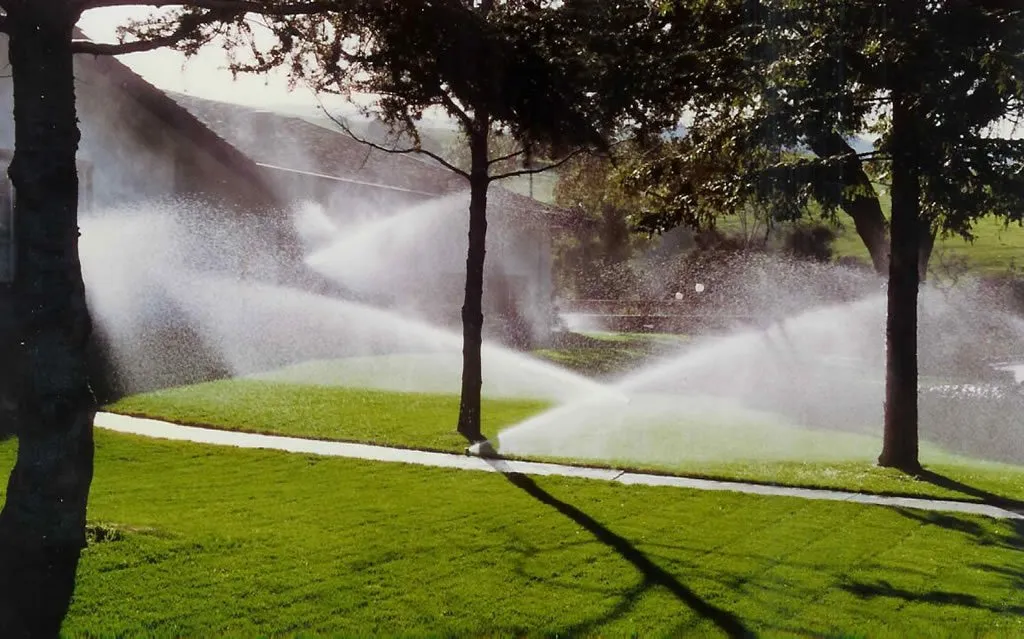
Photo A, no bueno! Notice the difference between A and B, the vertical spray. In photo B, from the start of the sprinkler head to where the water ends, grass is getting wet and it is noticeable. If you cannot see the mist between the top of the spray and the grass, it is not enough water! That mist should be easily visible. The condition of the sprinkler head, water pressure and the proximity of the sprinkler heads all play a role into creating an effective irrigation system. Photo A will also cause issues when seeding in the fall time!
SIGNS OF HEAT STRESS
Gradual browning in-between brown spots is a clear indicator of heat stress. Textbook disease still has green around brown spots. Now, you will always find disease in heat stress, but when grass is stressed out, it can easily get sick, like us! Take a look at pics below, sections of brown, then sections of green. Same amount of sunlight, why disease in just one spot? The type of grass does play a role and small sections of certain types of grass can have similar browning, but that is not the case in these pictures. If you have these issues, don’t increase the duration of your water schedule! Over watering will cause more problems by watering down the products, increasing the chance of disease, and it will bring on more weeds. Adjust the heads, check water pressure and make sure heads are not too far apart (up to 20′). This is, by far, the most common problem in summer months, especially during long, hot periods with no rain.





Free Instant Estimate
Your information is private and will not be used for other purposes.